O Driscoll Castles
At the peak of the O'Driscoll Clan's power, there were many castles belonging
to the clan. The castles are probably best described as
"Fortified Houses". All the castles were destroyed or
partially demolished in various disturbances between the clan and other clans or
foreigners, particularly in the period, when O'Driscoll Clan power, and control, of
land began to wane.
Dun na Sead

In Baltimore is the "Fort of Jewels"
the remains of the O'Driscoll Castle, Dún na
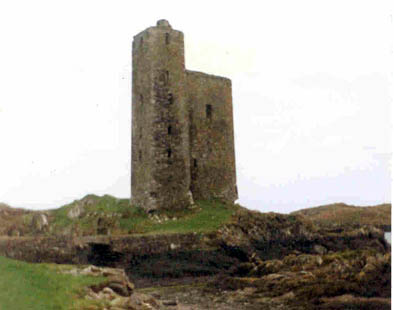
Séad, towers over the village and is a reminder of the once powerful O'Driscoll clan who controlled much of the South West for a number of centuries. This castle has been bought by a local lawyer, a McCarthy of all people, who is
restoring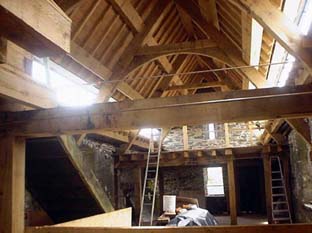 it to be used as a home. It has
also been opened to clan members on the occasion of the annual Clan
Gathering. it to be used as a home. It has
also been opened to clan members on the occasion of the annual Clan
Gathering.
In recent years the new owners have been kind enough to allow the Clan
Gathering to assemble in the castle on the opening night of the
gathering.
Dún an Óir
Another relic of the
medieval period is the strikingly situated Caisleán Dhún an Óir. The
promontory on which it stands is now effectively an island at high tide,
preventing safe access. Dún an Óir - the golden fortress, may have got
its name from the gold supposed to be secreted there or perhaps from its
lustrous appearance in the setting sun.
Either way, the legends of its
master Finín Ó Drisceoil and of the Giolla Dubh make it a very romantic
place. Finín the Rover occupied the fortress in the 16th century and held sway
over the islands of Sherkin and Cléíre, as well as mai
 nland
territory from Baltimore to Skibbereen. nland
territory from Baltimore to Skibbereen.
The castle was taken by Captain Harvey in 1602, in reprisal for the O'Driscolls having reportedly
piloted the Spanish into Kinsale. Built partly in the thirteenth century Norman style,
the castle consisted of a thick-walled tower having two courts. Captain Harvey's destructive work
on the masonry has been effectively completed by the passing centuries. Although the
castle cannot be reached without difficulty, the view from it's
precincts is rewarding. To the south an enormous
precipice rises above the castle tower, while on the north the wide bay with
it's low islands sweeps out to Mount Gabriel and Mizen Head, the most southerly point of the mainland.
Dun na Long
Sherkin Island is a mere ten minutes by boat from the small fishing
port of Baltimore on the mainland. The island is home to a 15th century Franciscan Friary
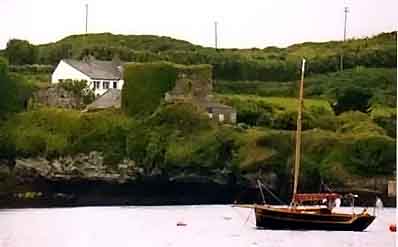
and one of the ruined O'Driscoll Castles, Dun
na Long "Fort of Ships".
In 1537, a ship, the Santa Maria De Soci, was bound for
 Waterford from Lisbon with a cargo of wine. This ship was forced to take shelter in
Baltimore from a storm, and while there, it was set upon and plundered
by O'Driscoll pirates. When the people of Waterford heard of this
incident they were so enraged, that they dispatched a naval expedition against the
island. An armed force
Waterford from Lisbon with a cargo of wine. This ship was forced to take shelter in
Baltimore from a storm, and while there, it was set upon and plundered
by O'Driscoll pirates. When the people of Waterford heard of this
incident they were so enraged, that they dispatched a naval expedition against the
island. An armed force
 landed at Dun-na-Long castle, seat of the
O'Driscoll clan, broke it down and reduced it almost to ruins. They overran the island for five days and
burned the villages. They attacked and plundered the Friary, taking with them
chalices and other spoils, including the great bell. They then proceeded
to Baltimore and continued to wreak havoc before returning home to
Waterford, well and truly avenged
landed at Dun-na-Long castle, seat of the
O'Driscoll clan, broke it down and reduced it almost to ruins. They overran the island for five days and
burned the villages. They attacked and plundered the Friary, taking with them
chalices and other spoils, including the great bell. They then proceeded
to Baltimore and continued to wreak havoc before returning home to
Waterford, well and truly avenged
Rincolisky (Whitehall) Castle
This castle belongs to the might of the O'Driscoll clan. The
O'Driscolls were one of the strongest clans around in the 17th century,
especially around Baltimore and the islands. They had castles in
Baltimore and neighboring areas and Whitehall castle was another example
of their power. It is worth noting that the McCarthy's and the
O'Driscoll's in this part of the Cork were on good terms and respected
each other. They did not attack each other and often helped each other
in times of need.
The earlier name of Whitehall Castle was Rincolisky castle
but after the English taking over the castle it was changed to Whitehall
after the name of the townland. It was built in 1495 by the O'Driscoll
clan. What remains of the castle is the lower portion of a
standard five storey tower house of that time.
 Entry to the
residential part of the building on the first floor is through a nicely
carved door above the basement entry. From this mural stairs on the left
lead upwards, and the main hall has an arched ceiling which is in
perfect condition. The floors above this area are severely damaged and
the castle is truncated from the second floor. Whitehall is on a hillock
near the shore, to which the ground descends fairly steeply.
Entry to the
residential part of the building on the first floor is through a nicely
carved door above the basement entry. From this mural stairs on the left
lead upwards, and the main hall has an arched ceiling which is in
perfect condition. The floors above this area are severely damaged and
the castle is truncated from the second floor. Whitehall is on a hillock
near the shore, to which the ground descends fairly steeply.
Following the battle of Kinsale the British forces began
their sweep of all castles in the Carbery region and throughout Cork.
On 29th of April 1602 this castle became no exception as the English
forces had little difficulty in taking over the castle. Sir Walter
Coppinger took over the castle and the property and laid rest there.
In 1690 the Coppingers lost their land , because they supported James
ll and the castle was given to the Townsends. The Townsends knocked the
upper floors of the castle to build Whitehall house. Since then, the
castle has remained untouched only by the natural elements. Some
say that their is a tunnel leading from the house to the castle but it
has never been found. One of the Townsends sent his little page boy down
the passage to see if it was clear. The boy was never seen again.
|
Cloghan Stony Place
For
sheer beauty the castle ruins on Cloghan Island in Lough Ine must
stand as the most idyllic.
At the centre of the lake is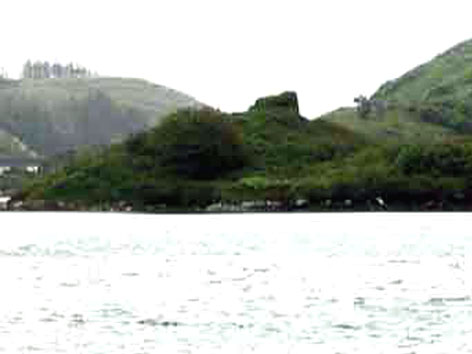 Cloghan Island, last resting place of Finín the Rover. The
Island
casts mysterious, moonlit shadows across the water on a still
summer's evening, hinting at the sad secrets of one of its earliest
occupants. The island was, reputedly, the home of Labhrás, pre-christian
Chieftain of the Carberies, who took refuge
there when his spurned wife cursed him to bear horse's ears for his
lifetime. To hide his shame he fled to Cloghan Island, wearing his
hair long. On occasions when a barber cut his hair, he
was summarily executed on the orders of Labhrás, lest his secret be
revealed.
Cloghan Island, last resting place of Finín the Rover. The
Island
casts mysterious, moonlit shadows across the water on a still
summer's evening, hinting at the sad secrets of one of its earliest
occupants. The island was, reputedly, the home of Labhrás, pre-christian
Chieftain of the Carberies, who took refuge
there when his spurned wife cursed him to bear horse's ears for his
lifetime. To hide his shame he fled to Cloghan Island, wearing his
hair long. On occasions when a barber cut his hair, he
was summarily executed on the orders of Labhrás, lest his secret be
revealed.
News of this savage and unexplained behaviour spread wide and struck
fear into the heart of a widow woman when her only son was summoned
as hairdresser to the chieftain. She made her way to
Lough Ine, intruded the inner sanctum and threw herself at the mercy
of Labhrás. Despite misgivings,
 succumbed to the widow's entreaties and the youth was spared, on the
strength of a solemn promise not to reveal the secret to a living
soul.
As the
barber grew up he became increasingly depressed, burdened with the
enormity of his secret. His health began to fail and he
consulted a healer. He couldn't tell his secret to a living
soul, but the weight of it would kill him. The healer
advised him to tell his tale to a tree, which wouldn't betray his
chieftain's confidence.
succumbed to the widow's entreaties and the youth was spared, on the
strength of a solemn promise not to reveal the secret to a living
soul.
As the
barber grew up he became increasingly depressed, burdened with the
enormity of his secret. His health began to fail and he
consulted a healer. He couldn't tell his secret to a living
soul, but the weight of it would kill him. The healer
advised him to tell his tale to a tree, which wouldn't betray his
chieftain's confidence.
The man went and whispered his heavy secret to an oak tree in the
centre of a deep forest and, immediately, on hisrelease from the
strain, he recovered his spirit and health. Some time
later a travelling musician wandered into the oak forest, in search
of the perfect tree from which to fashion a cláirseach (harp) that
would enchant all who heard it. As luck would have it,
the barber's tree called out to him, impressing him with its fine
lines and solid structure. He had it chopped down and
laboured for many's a day on fashioning the finest harp that was
ever seen in Ireland.
The instrument made, the harpist came
to the court of Labhrás to display its magnificence at a gathering
of the clans of Carbery. The feasting was done, the
crowds silenced in anticipation of the musical feast in store.
Howls of laughter and derision followed when the only music
emanating from the harp was Labhrás the King has horses' ears,
prompting the immediate suicide of the poor, benighted leader.
KilcoeCastle
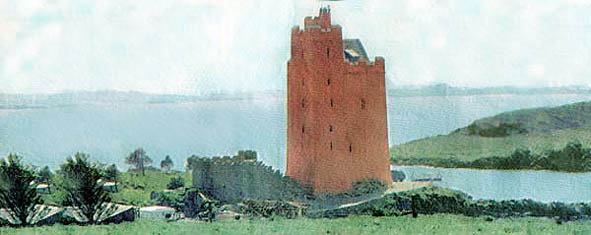
Kilcoe castle was built around the year of 1450 by the Clan of Dermort McCarthy on a
2-acre island.
 These McCarthys were a sub-tribe of the McCarthy Rioch of Kilbrittan where they originated from Blarney. At this time McCarthy's
were one of the leading families in Munster and had land all around Cork
especially West Cork. They built the castle at this point, on the edge
of Roaringwater bay because of its defensive position. Kilcoe castle is
built on an island, one side of the island is too shallow for boats to enter and on the other side is another island (Mannin island). This is
the main reason why the English had so much trouble taking the castle
because the ships couldn't get close enough for the cannons to have good
aim.
These McCarthys were a sub-tribe of the McCarthy Rioch of Kilbrittan where they originated from Blarney. At this time McCarthy's
were one of the leading families in Munster and had land all around Cork
especially West Cork. They built the castle at this point, on the edge
of Roaringwater bay because of its defensive position. Kilcoe castle is
built on an island, one side of the island is too shallow for boats to enter and on the other side is another island (Mannin island). This is
the main reason why the English had so much trouble taking the castle
because the ships couldn't get close enough for the cannons to have good
aim.
As the English forces began to take over Irish lands and
castles, due to their superior strength the English had little problems
in taking over
in West Cork except for Kilcoe which was the only castle in Carbery (West Cork) to hold out in rebellion. Many of these
castles were taken over by Captain Harvey, a cousin to Sir George Carew
an English Commander, and he tried many times to take over Kilcoe
castle.
In 1600 Sir Richard Perry marched with some of the
garrison of Kinsale in order to reduce
Kilcoe. He didn't succeed but
took 300 heads of
 cattle. This was one of the many attacks on the
castle, but due to the bravery of the residents they failed. On the
20th of April 1602 the Earl of Thousand's men took shelter in the
castle, one of these being Conor O'Driscoll. The castle survived
a long
siege and during the siege all the occupants left the castle except for Conor. Finally in February 1603 Conor surrender to Captain George
Flower, the subordinate of Captain Harvey. It was the last place in West
Cork to do so. Before the long siege started Captain Harvey died of a
broken heart at Baltimore because of his failure to capture Kilcoe
Castle. cattle. This was one of the many attacks on the
castle, but due to the bravery of the residents they failed. On the
20th of April 1602 the Earl of Thousand's men took shelter in the
castle, one of these being Conor O'Driscoll. The castle survived
a long
siege and during the siege all the occupants left the castle except for Conor. Finally in February 1603 Conor surrender to Captain George
Flower, the subordinate of Captain Harvey. It was the last place in West
Cork to do so. Before the long siege started Captain Harvey died of a
broken heart at Baltimore because of his failure to capture Kilcoe
Castle.
After the siege of the castle the older McCarthy lived and
died in a small house in Mannin island. After the McCathy's left the
castle it was occupied shortly by a number of English people. And after
1640 the castle was never occupied again. Since then the castle has
passed through a number of hands. At the start of the 19th century the English
left it for the people who farmer the land. Up to 1966 nobody
owned the castle until James Caverly, the local farmer, registered the
castle and in 1972 sold it to Edward F.Samuel. He built a bridge
connecting the castle to the main land but decided not to restore it. He
then sold to Jeremy Irons, who is at the moment restoring it. It is suggested that the castle was built on the site of
another building. This is because at the bottom the walls are 10 feet thick while the walls at the top are only 2-3
feet thick. The stone for the walls was quarried from Mannin island and
it is said that animals blood was used within the mortar to strengthen
it. There was no bridge connecting , so you could only get access to the
castle at half tide or less. The castle is 93 feet in height and stands
proudly casting its shadow over roaringwater bay.
The peach/pink shade chosen by actor Jeremy Irons to paint the
listed 15th century castle is a mixture of lime-wash and sulphate
and will oxidise, and fade in colour.
|